The Quiet Death of the Field: A Winter Morning on the Backroads
Early winter mornings on the backroads remind me how quiet and sharp the world can be. Frosted fields, ghostly fog, and a fiery sunrise whisper of endings and cycles we often forget. Modern life shields us from the earth’s rhythms, but standing in the cold, camera in hand, I feel tethered to something older— humbling and beautiful. Even in frost, there is memory.
STORIES
JJ Everitt
12/1/20253 min read
Early winter mornings on the backroads have a way of slowing time down, even if just a little.
The fields are frosted, the air is sharp, and the sky is pale with that first light that doesn’t quite feel warm yet. I’ve been trying to take pictures in this cold, but it’s getting harder. No gloves, frozen fingers, stiff hands that make even the simplest adjustments on my camera a challenge. But I keep going. I can’t help it. There’s something about the quiet and the frost that I want to hold onto, even if it hurts a little.
This morning, I stopped to photograph a scene that, to me, felt like death.
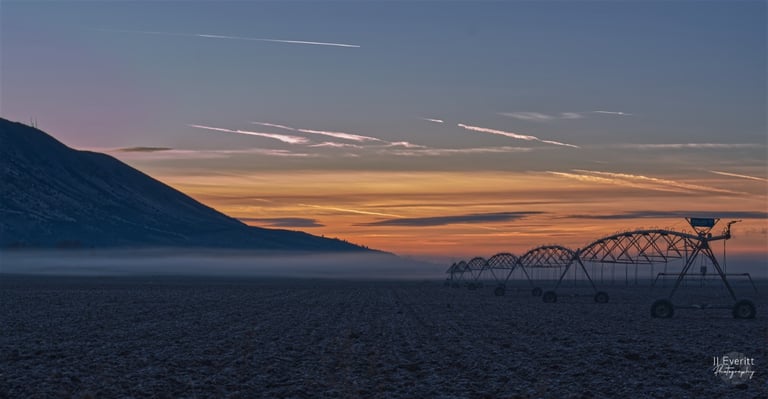
Not dramatic, not sudden, just the quiet end of a cycle. On the left of the image, a dark cyan mountainside slopes steadily toward the center. On the right, an industrial-sized agriculture sprayer leans toward the same point. The horizon is a thick, rolling line of white fog, floating above the fields like a ghost, neither touching the ground nor blending into the sky. The sky itself shifts from a foggy blue to a soft tangerine where the sunrise struggles through the haze. In the foreground, the field is bare and frozen, with mounds of frosted dirt left behind by the season’s cold.
It’s a scene that captures the end of harvest. Everything that grew has been collected or has died back. The land rests. The machinery sits idle. And I can’t help but notice how much has changed since farming was the central concern of survival. We no longer worry about whether the harvest will come in. We don’t fear that food won’t be there in winter. Grocery stores are stocked, delivery apps are ready, and most of us assume that life will just continue the way it always has.
And yet, while all of this convenience is remarkable, it comes with a loss.
We’ve lost connection to the land. We’ve lost the intimate understanding of labor and risk that farmers and ranchers face every year. The machinery and the mountainside in my photograph tell a story of human effort and natural cycles, but it’s a story we rarely think about anymore. I can drive past these fields, take my picture, and return home to a warm kitchen and stocked pantry without ever considering what it took to get here.
\\There’s a small, ironic personal note in all of this, too. Over the past few days, I’ve been working through Thanksgiving leftovers. Trying not to waste anything. Turkey in five different forms, mashed potatoes, stuffing. I can’t say it hasn’t started to get to me. But even that, mundane as it is, reminds me of the layers of convenience we’ve built into modern life. We’re so far removed from the reality of growing, harvesting, and storing food that even running out of ideas for leftover turkey can feel like a minor frustration.
Standing there in the cold, camera in hand, looking at the frosted field, I felt the tension between that convenience and what’s been lost. Progress has made survival easier, more predictable, and often more comfortable, but it has also removed a lot of the respect for the work and risk that once sustained us. Observing the field, the fog, the sunrise, and the idle sprayer reminded me that there’s a quiet power in cycles that we no longer live by but still depend on.
The frost doesn’t care about our comfort, and the earth continues its rhythm, even when we forget to pay attention.
I left the field this morning with frozen fingers, a camera full of images, and a reminder. Winter is hard. The mornings are cold. The landscape can feel stark, empty, and unforgiving. But there’s value in paying attention, in noticing the end of the harvest, in recognizing the work that continues even when it’s out of sight. There’s a lesson in endurance, even in the small act of standing there and documenting what the frost leaves behind.
This site is not intended to provide and does not constitute medical, legal, or other professional advice. The content on The Zen Thing is designed to support, not replace, medical, psychological, or psychiatric treatment. If you believe you may have a medical or mental health condition, please seek care from a qualified professional.
This space was created through experimentation, failure, and rebuilding. Everything shared here comes from lived experience, not theory. The focus is on what makes daily life easier to manage.